The old school of search engine optimization taught a simple, binary rule: build a high-quality website, then spend every waking hour hunting for backlinks. For years, we scoured resource lists, sent thousands of cold outreach emails, and negotiated guest posts just to move the needle on Domain Authority.
But if you’ve been watching the search results lately, you’ve noticed a major paradigm shift. Sites with significantly fewer inbound links are outranking established giants simply because they publish more often. This shift toward content velocity means the volume and frequency of your updates now carry as much weight as your backlink profile. To keep up with this demanding pace without burning out your team, savvy marketers are integrating an SEO article generator to maintain a relentless publishing schedule that keeps search engines coming back for more.
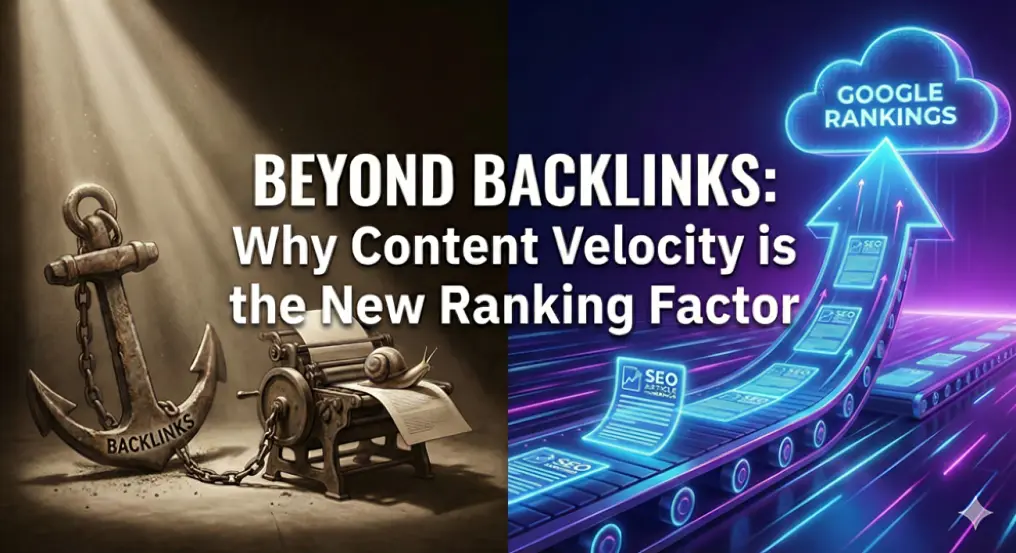




The Death of the “Slow and Steady” Blog
For the better part of a decade, the standard advice from marketing agencies was to “publish one high-quality post per week.” While that advice sounds noble, it is entirely insufficient to dominate a competitive niche in 2026. The internet is noisier, user queries are more fragmented, and Google’s crawlers now heavily prioritize websites that demonstrate active, daily growth and deep topical coverage.
Let’s look at the math behind this shift:
- Low Velocity (4 posts per month): You are giving search engines exactly 4 reasons to visit your site every 30 days. If a competitor covers a trending industry topic on Tuesday and you wait for your scheduled Friday post, you’ve already missed the traffic spike.
- High Velocity (30 to 60+ posts per month): You provide dozens of new entry points for organic traffic. You blanket your niche, answering every conceivable variation of your customer’s questions.
The problem with high-velocity SEO isn’t the strategy; it’s the execution. Writing 30 highly optimized, technically sound articles a month by hand is a grueling, full-time job. However, once you understand how end-to-end SEO automation works, you can bypass the traditional bottlenecks. By adopting automated workflows, you aren’t just “spinning” old content – you are building a massive, interconnected library of information that signals definitive authority to Google.
Manual vs. Automated Content Strategy
| Feature | Manual SEO Blogging | Automated Content Workflows |
| Output | 1–4 posts per month | 30–60+ posts per month |
| Cost | High ($100–$500 per article) | Low ($1–$5 per article) |
| Topical Coverage | Surface level (Broad, highly competitive topics) | Deep (Long-tail, zero-volume clusters) |
| Speed to Rank | Slow (6–12 months for traction) | Fast (Aggressive indexing and entity building) |
The Mechanics of Content Velocity
Content velocity is the rate at which you publish content over a specific period. Think of it like a snowball rolling down a hill:
- Low Velocity: The snowball stays small. It barely moves, and the competition (who are pushing harder) melts it faster than it grows.
- High Velocity: The snowball grows rapidly. It picks up momentum and absorbs highly specific “zero-volume” keywords. These are search terms so specific that standard tools like Ahrefs or Semrush don’t even track them yet, but real humans are typing them into search bars every single day.
The Science of Crawl Budget and Indexing
Google assigns every website a “Crawl Budget” – which is essentially the amount of computing time and energy Googlebot is willing to spend crawling your pages. When you publish infrequently, Googlebot’s algorithms learn that your site is mostly static. Consequently, it visits less often, meaning when you do publish, it takes much longer for that content to appear in search results.
Scaling your output fundamentally changes this dynamic. When you publish daily, you train the crawlers to visit your site daily. This is exactly why websites that publish daily win long-term. Consistent activity signals that your site is a “living,” breathing resource. This leads to near-instant indexing and a compounding effect on your overall domain authority.
Solving the “Quality vs. Quantity” Debate
For years, content creators operated under the misconception that you had to choose between writing something great and writing something fast. Today, modern AI infrastructure handles the heavy lifting of research, semantic structuring, and HTML formatting.
Instead of staring at a blank cursor for three hours, you can use a sophisticated SEO article generator to create a technically perfect, structurally sound 1,500-word foundation in seconds.
The “Information Gain” Factor
Make no mistake: Google is highly adept at identifying pure, unedited “fluff.” In 2026, the algorithm actively rewards Information Gain – the practice of providing new data, unique perspectives, or expert insights that are not found in the current top 10 search results.

Automation tools provide the structural skeleton. They ensure the keyword density is right, the H2s and H3s make logical sense, and the schema markup is present. Your role shifts from writer to editor. You inject the unique insights that make the piece valuable.
The Economics of Topical Authority
Google’s ultimate goal is to provide the most comprehensive answer to a user’s query. If Site A has 10 beautifully written articles on “Sustainable Gardening,” but Site B has 200 well-structured articles covering every specific soil type, plant disease, and climate zone, Site B will almost always win the traffic.
Generators allow you to quickly and economically fill in these topical “gaps,” building a complete Topical Map that proves to Google you are the definitive expert in your vertical.
The 6-Layer Workflow for Content Automation
If you want to move beyond the exhausting treadmill of link-hunting and start building a true content empire, you need a system. Follow this blueprint:
1. Keyword Research and Intent Modeling
Don’t just target high-volume “head” terms that are dominated by Wikipedia or Forbes. Focus on “Problem Awareness” keywords. What are the hyper-specific, operational challenges your audience faces daily? Map out these pain points and use an SEO article generator to draft hundreds of short, highly targeted, and helpful guides addressing each one.
2. Strategic Content Orchestration
High velocity is not an excuse to flood the web with random filler. Structure your output logically:
- Pillar Pages: Comprehensive 2,500-word guides that cover a broad topic.
- Cluster Posts: 800-word articles answering specific, long-tail questions that link back to the Pillar.
- FAQ Knowledge Blocks: Short snippets designed specifically to capture “Position Zero” and voice search queries.
3. The “Human-in-the-Loop” Edit
Even the best AI requires a final sanity check. Spend 10 to 15 minutes on each generated article to:
- Ensure your unique brand voice and tone are consistent.
- Add proprietary data, a unique quote, or custom screenshots.
- Verify that formatting is clean and highly scannable for mobile readers.
4. Automated Internal Linking
Internal links are the “roads” connecting your content. High velocity only works if those roads make sense. Use automated scripts or built-in CMS tools to map internal links dynamically, bridging the semantic gaps between your older legacy posts and your new daily publications.
5. Multichannel Repurposing
Don’t let your content live in a silo. Turn your published articles into scripts for short-form videos, email newsletters, or LinkedIn carousels. A single article generated today can amplify your brand signals across five different platforms tomorrow.
6. Analytics and Content Pruning
Velocity requires monitoring. After 90 days, review your analytics. Articles that are driving traffic should be expanded upon. Articles that are getting impressions but no clicks need their meta titles and internal links optimized.
The Symbiosis: Content Velocity and Backlinks
To be absolutely clear: backlinks still matter. They remain the internet’s primary “votes of confidence.” However, the context of a backlink has changed. A backlink pointing to a dead site that hasn’t been updated in six months is worth far less than a backlink pointing to a vibrant, frequently updated resource.
When you do engage in digital PR, guest posting, or directory outreach, those earned links will work ten times harder if the destination site is growing every day.
Think of your backlinks as the fuel and your content velocity as the engine. You need both to win the race, but a high-performance, well-oiled engine can get much further on significantly less fuel.
Technical SEO in a High-Velocity Environment
As you scale your content production, you must maintain a pristine technical foundation. A massive site with crawl errors, broken links, or slow load times will eventually collapse under its own weight and lose its rankings. Keep your site architecture shallow – ensure every single article is reachable within three clicks from the homepage. Furthermore, guarantee your automated layouts are mobile-first, as Google evaluates the mobile version of your site exclusively.
The Future: Generative Engine Optimization (GEO)
We are rapidly moving away from traditional “Search Engines” and toward “Answer Engines.” Users no longer want a list of ten blue links; they expect direct utility and immediate answers synthesized by AI.
By maintaining a high content velocity, you drastically increase the surface area of your website. You increase the statistical probability that your highly structured, citation-ready content will be pulled into AI Overviews and Large Language Models (LLMs) like Google Gemini, ChatGPT, or Perplexity.
Mass-produced content only fails when it lacks structure. A modern SEO article generator ensures your data is fundamentally “citation-ready” by utilizing transparent sourcing and structured schema markup (like FAQ and How-To schema), making it incredibly easy for an AI to parse your content and serve it directly to the user.
Conclusion: Scaling for the 2026 Search Landscape
The days of “build it and they will come” are officially over. Today, you must build it, update it, and expand it – constantly and consistently. By shifting your focus away from a purely backlink-driven strategy and toward content velocity, you create a dynamic, authoritative presence that Google’s algorithms simply cannot ignore.
Don’t let the fear of automation or the nostalgia for the “old days” of SEO hold your business back. The smartest, highest-earning marketing teams are already seamlessly blending human creativity with automated efficiency.
Start small if you need to. Pick 10 cluster topics you’ve been meaning to write about for months, run them through your automated workflow, and get them live this week. You will be genuinely surprised at how quickly the search engines react when you finally start giving them exactly what they want: a steady, high-velocity stream of fresh, relevant, and highly structured information.