Did you know programmatic advertising began nearly thirty years ago within early digital ecosystems? What started as simple banner placement has grown into a data-driven advertising system today. This growth reflects changes in technology, consumer behavior, and digital platforms worldwide.
Programmatic advertising is no longer optional for businesses competing in modern digital markets. It supports automated ad buying, accurate targeting, and performance-based campaign optimization. Instead of manual negotiations, advertisers now rely on algorithms and real-time data insights.
Today, it helps brands connect with audiences efficiently across multiple digital channels. It combines technology, data, and analytics to improve advertising accuracy and performance.




This informative article explains programmatic advertising, its working process, benefits, challenges, and future potential.
What Is Programmatic Advertising?
Programmatic advertising is an automated method for buying and placing digital advertisements online. It replaces traditional manual ad buying with software-driven systems and algorithms.
This approach uses data and artificial intelligence to decide ad placements instantly. Advertisers no longer need direct communication with publishers for every placement decision.

It focuses on showing relevant ads to the right users at suitable moments. It increases efficiency while reducing wasted impressions and unnecessary spending.
At its core, it helps businesses reach audiences based on behavior and intent. This allows more precise targeting compared to traditional digital advertising methods.
Types of Programmatic Advertising
Programmatic advertising can be categorized into different types based on how ads are bought, sold, and delivered. Each type serves a specific purpose depending on campaign goals, budget, and targeting strategy.
1. Open Auction (Real-Time Bidding – RTB)
Open auction is the most common type of programmatic advertising, where advertisers bid for ad impressions in real time through an automated auction.
How it works:
- Publishers make their ad inventory available on an ad exchange
- Advertisers bid through a DSP
- The highest bidder wins the impression instantly
Best for: Brand awareness and large-scale reach
Pros: Low cost, massive inventory
Cons: Lower control over ad placements
2. Private Marketplace (PMP)
Private Marketplace is an invite-only auction where premium publishers offer inventory to selected advertisers.
Key features:
- Only invited advertisers can bid
- Higher-quality inventory than open auctions
- More transparency and brand safety
Best for: Premium brands and targeted campaigns
Cons: Higher CPM than open auctions
3. Programmatic Guaranteed (Automated Guaranteed / Direct)
In programmatic guaranteed deals, advertisers and publishers agree on price, volume, and placements in advance, but ads are delivered programmatically.
Key benefits:
- Fixed price and guaranteed impressions
- Premium ad placements
- No bidding competition
Best for: High-impact campaigns and brand campaigns
Cons: Expensive compared to auctions
4. Preferred Deals
Preferred deals are one-to-one agreements between advertisers and publishers where the advertiser gets first access to inventory at a negotiated price.
How it differs from PMP:
- No auction competition
- Advertiser can choose whether to buy impressions
Best for: Brands wanting premium inventory without auctions
5. Header Bidding
Header bidding is an advanced programmatic technique where multiple ad exchanges bid simultaneously before the ad server call.
Why it matters:
- Increases publisher revenue
- Creates fair competition among demand sources
- Improves transparency
Best for: Publishers and advanced advertisers
Cons: Complex to implement
6. Contextual Programmatic Advertising
Contextual programmatic targets users based on webpage content instead of cookies or personal data.
Example:
- Showing sports ads on sports websites
Best for: Cookieless future and privacy compliance
Privacy-friendly targeting method
7. Audience-Based Programmatic Advertising
This type uses data to target specific user segments such as:
- Demographics
- Interests
- Purchase intent
- Retargeting audiences
Data sources include:
- First-party data
- Second-party data
- Third-party data
Evolution of Programmatic Advertising
Early digital advertising relied heavily on manual banner placements across selected websites. Advertisers negotiated prices, positions, and durations directly with publishers.
As internet usage expanded, manual processes became slow and inefficient for advertisers. Programmatic technology emerged to handle growing data and advertising demand efficiently.
Advancements in artificial intelligence and machine learning strengthened programmatic systems significantly. These tools enabled real-time bidding and audience segmentation at scale.
Today, it powers display ads, video ads, mobile ads, and social media campaigns. It has become a central component of digital marketing strategies worldwide.
How Programmatic Advertising Works?
Programmatic advertising works through automated systems that analyze user data continuously. These systems process browsing behavior, interests, demographics, and previous ad interactions.
When a user visits a website, an instant auction occurs behind the scenes. Advertisers bid for the impression based on relevance and campaign goals.
The highest bidder wins the placement, and the ad appears immediately. This entire process happens within milliseconds without human involvement.
Machine learning algorithms improve campaign decisions based on real-time performance data. This improves accuracy, engagement rates, and overall campaign efficiency.
Programmatic systems ensure ads reach users when they are most likely to respond. This leads to higher engagement and improved conversion opportunities for businesses.
Key Technologies Behind Programmatic Advertising
Several technologies support the programmatic advertising ecosystem and its daily operations. Each component plays a specific role in ad buying and selling processes.

Demand-Side Platforms (DSPs) – It allows advertisers to manage and buy ad inventory across multiple platforms. Advertisers set targeting rules, budgets, and bidding strategies within DSP dashboards.
Sell-Side Platforms (SSPs) – It helps publishers sell available ad space to advertisers through auctions. These platforms maximize revenue by connecting publishers with multiple demand sources.
Ad Exchanges – It function as digital marketplaces for buying and selling ad impressions. They connect DSPs and SSPs through automated real-time bidding environments.
Data Management Platforms (DMPs) – It collects and organize user data for better audience segmentation. This data supports precise targeting and improved personalization strategies.
DSP vs SSP vs DMP: Comparison
| Feature | DSP (Demand-Side Platform) | SSP (Supply-Side Platform) | DMP (Data Management Platform) |
|---|---|---|---|
| Full Form | Demand-Side Platform | Supply-Side Platform | Data Management Platform |
| Used By | Advertisers & agencies | Publishers & media owners | Advertisers, publishers, and marketers |
| Main Purpose | Buy ads programmatically | Sell ad inventory programmatically | Collect, manage, and analyze audience data |
| Role in Programmatic | Helps advertisers bid on ad impressions | Helps publishers monetize ad space | Provides data for targeting and segmentation |
| Works With | Ad exchanges, SSPs, DMPs | Publishers, ad exchanges, DSPs | DSPs, SSPs, CRM, analytics tools |
| Key Features | RTB bidding, targeting, campaign optimization, budget control | Yield optimization, ad inventory management, real-time auctions | Audience segmentation, data analytics, user profiling |
| Data Usage | Uses audience data to target ads | Shares inventory and performance data | Collects first, second, and third-party data |
| Pricing Model | CPM, CPC, CPA | Revenue share or platform fees | Subscription or data usage fee |
| Examples | Google DV360, The Trade Desk, MediaMath, Amazon DSP | Google Ad Manager, OpenX, Magnite, PubMatic | Adobe Audience Manager, Oracle BlueKai, Salesforce DMP |
| Who Makes Money? | Advertisers spend money | Publishers earn money | Both advertisers and publishers gain insights |
Programmatic Advertising Channels
It operates across several digital channels effectively. This flexibility allows marketers to reach users wherever they spend time online.
Each channel supports different campaign objectives and audience engagement strategies.
Common programmatic advertising channels include:
- Display advertising on websites and blogs
- Mobile advertising within apps and mobile browsers
- Video advertising across streaming platforms
- Social media advertising through automated placements
Programmatic Advertising vs Digital Advertising
In simple words, programmatic advertising improves digital advertising through automation and data usage.
Digital advertising includes all forms of paid online promotions across digital platforms. This includes display ads, search ads, social ads, and video campaigns.
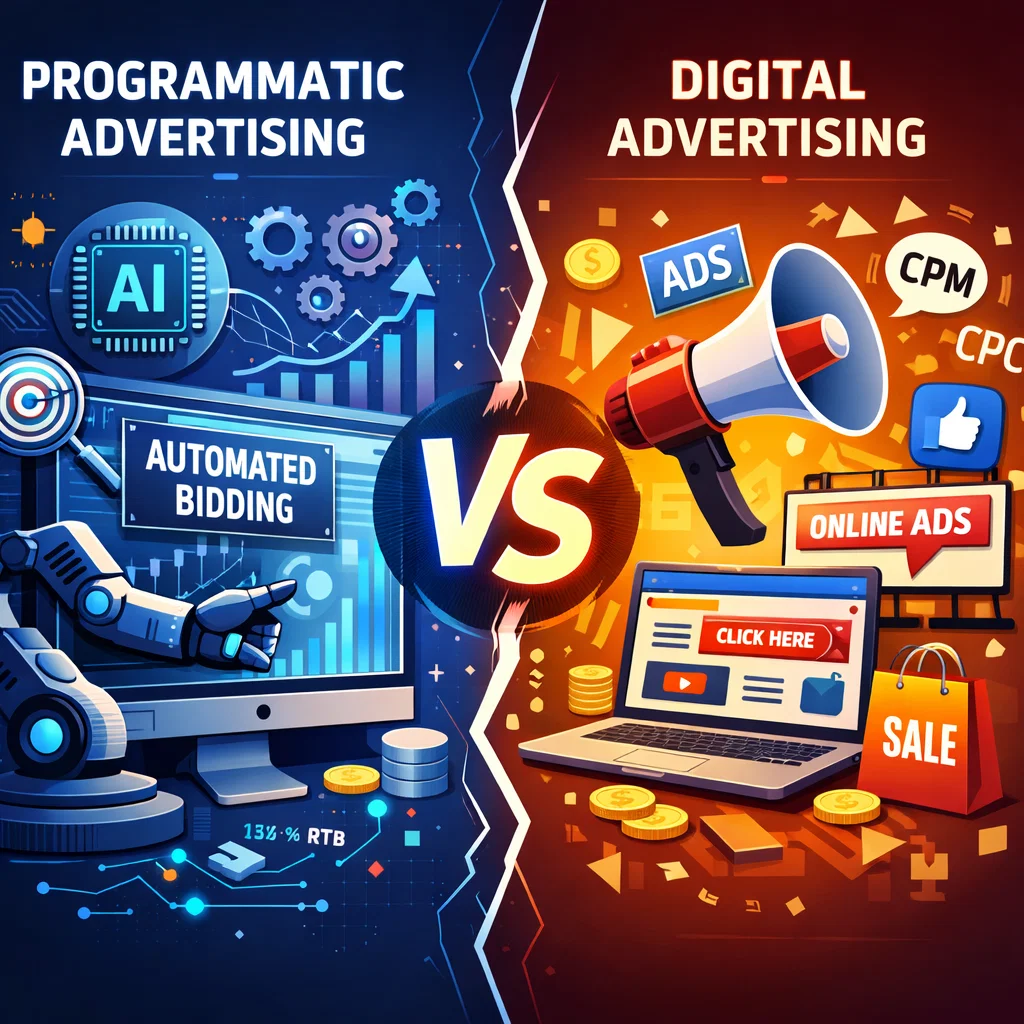
Programmatic advertising is a subset of digital advertising using automated buying systems. It focuses on efficiency, targeting precision, and real-time optimization.
Traditional digital advertising often involves manual planning and placement decisions. Programmatic advertising removes these manual steps through automated decision systems.
Benefits of Programmatic Advertising
Programmatic advertising offers several advantages for businesses seeking scalable digital growth. These benefits improve efficiency, targeting accuracy, and campaign performance.
Efficiency and Time Saving
Automation removes manual negotiations, paperwork, and placement discussions completely. Marketers save valuable time and focus on strategy and creativity instead.
Campaigns launch faster and adjust automatically based on real-time data insights. This improves productivity across marketing teams significantly.
Improved Targeting and Personalization
Programmatic technology enables targeting beyond basic demographics and locations. Advertisers can reach users based on interests, behavior, and intent signals.
Personalized ads improve relevance, increasing engagement and conversion probabilities. Users receive messages aligned with their current needs and preferences.
Real-Time Data and Analytics
Programmatic platforms provide live campaign performance data continuously. Marketers monitor impressions, clicks, conversions, and engagement instantly.
This allows quick adjustments to bids, creatives, and targeting parameters. Real-time feedback improves campaign effectiveness and budget utilization.
Cost Effectiveness
Advertisers pay only for relevant impressions through real-time bidding models. This reduces wasted spend on irrelevant or low-quality audiences.
Better targeting ensures budgets generate measurable results and improved return on investment.
Scalability and Flexibility
Programmatic platforms support rapid scaling across channels and geographic regions. Campaigns expand or reduce based on performance and market conditions.
This flexibility helps brands respond quickly to trends and consumer behavior changes.
Challenges of Programmatic Advertising
Despite many advantages, programmatic advertising also presents certain challenges. Marketers must address these issues carefully for successful implementation.
Ad Fraud and Privacy Concerns
Ad fraud remains a significant challenge within automated advertising environments. Fake impressions and clicks reduce campaign accuracy and budget efficiency.
Privacy regulations require responsible data usage and compliance with legal standards. Marketers must balance personalization with ethical data handling practices.
Programmatic Ecosystem and Complexity
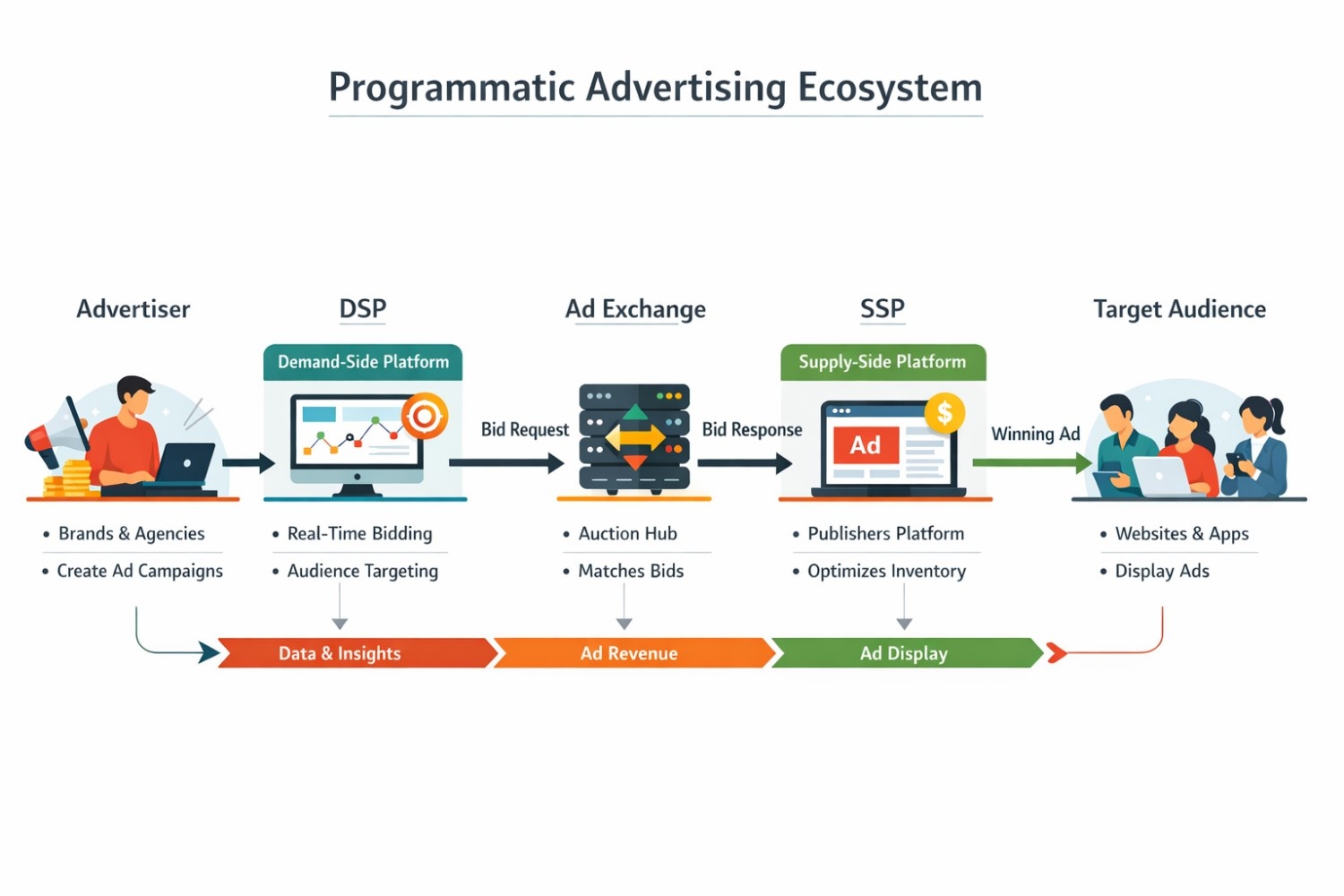
The programmatic ecosystem includes multiple platforms and technologies working together. Beginners may find integration and management challenging initially.
Understanding platform roles and workflows requires learning and continuous optimization efforts.
Platform and Partner Selection
Campaign success depends heavily on choosing reliable platforms and partners. Transparency, reporting accuracy, and data access are critical selection factors.
Working with experienced providers reduces risks and improves long-term performance outcomes.
Brand Safety and Inventory Quality
Ads may appear alongside unsuitable content without proper controls. This can affect brand reputation negatively.
Brand safety tools and quality inventory selection help prevent such issues.
Getting Started with Programmatic Advertising
Businesses entering programmatic advertising should understand foundational concepts clearly. These steps help beginners build effective campaigns confidently.
- Understand the Advertising Ecosystem
Learn how DSPs, SSPs, Ad Exchanges, and DMPs function together. This understanding helps manage campaigns and interpret performance data correctly.
- Define Audience Targeting Clearly
Identify customer demographics, interests, behaviors, and purchase intent carefully. Accurate targeting improves ad relevance and engagement rates significantly.
- Plan Budget and Bidding Strategy
Set clear budgets and bidding limits aligned with campaign objectives. Understand real-time bidding mechanics and cost control methods.
- Focus on Creative and Messaging
Ad visuals and messages must align with audience preferences and platform formats. Relevant creatives improve engagement and conversion outcomes.
- Measure and Optimize Performance
Track metrics like click-through rates, conversions, and return on ad spend. Use insights to refine targeting, bids, and creative strategies regularly.
The Future of Programmatic Advertising
Programmatic advertising continues evolving with advancements in artificial intelligence technologies. These improvements enhance targeting accuracy and predictive performance models.

Voice search, connected devices, and smart environments will expand advertising opportunities. Marketers must adapt strategies for emerging interaction formats.
Privacy-focused advertising will gain importance due to regulatory and consumer expectations. Ethical data practices and transparency will shape future programmatic ecosystems.
Enhanced personalization and immersive experiences will define upcoming programmatic advertising campaigns. Technology will continue transforming how brands engage digital audiences.
Final Words
Programmatic advertising has transformed digital marketing through automation, data usage, and real-time optimization. It supports efficient targeting, cost control, and scalable campaign execution.
Despite challenges like fraud and privacy concerns, its benefits outweigh limitations significantly. Businesses adopting programmatic advertising gain competitive advantages in digital environments.
Understanding the ecosystem, targeting strategies, and performance metrics ensures successful campaign implementation. Programmatic advertising remains essential for marketers aiming for sustainable digital growth.
Programmatic Advertising FAQs
What is programmatic advertising in simple language?
Programmatic advertising is an automated way to buy and show online ads using data.
How is programmatic advertising different from normal digital advertising?
Programmatic advertising uses automation and real-time data, unlike manual digital ad buying.
Who should use programmatic advertising?
Businesses, brands, and marketers wanting targeted, scalable, and data-driven advertising should use it.
Is programmatic advertising suitable for small businesses?
Yes, small businesses can use programmatic advertising with controlled budgets and focused targeting.
What platforms are used in programmatic advertising?
Common platforms include DSPs, SSPs, Ad Exchanges, and Data Management Platforms.
How does programmatic advertising target the right audience?
It uses user behavior, interests, location, and online activity data for accurate targeting.
Is programmatic advertising expensive?
Costs depend on targeting, competition, and bidding strategy, but budgets remain flexible.
What are the main benefits of programmatic advertising?
It offers automation, better targeting, real-time insights, cost control, and campaign flexibility.
What challenges exist in programmatic advertising?
Common challenges include ad fraud, privacy rules, platform complexity, and brand safety concerns.
How can beginners start with programmatic advertising?
Beginners should learn platforms, define audiences, plan budgets, test creatives, and track results.
Is programmatic better than Google Ads?
Programmatic advertising is better for large-scale display campaigns and advanced targeting, while Google Ads is easier for beginners and search-based ads.
What is the cost of programmatic advertising in India?
Programmatic advertising in India typically costs ₹50–₹500 CPM, depending on targeting, inventory quality, and platform.
Can small businesses use programmatic advertising?
Yes, small businesses can use programmatic advertising, but it is more effective for brands with larger budgets and data-driven campaigns.
What is programmatic guaranteed?
Programmatic guaranteed is a direct deal where advertisers and publishers agree on fixed price and impressions, delivered automatically without bidding.