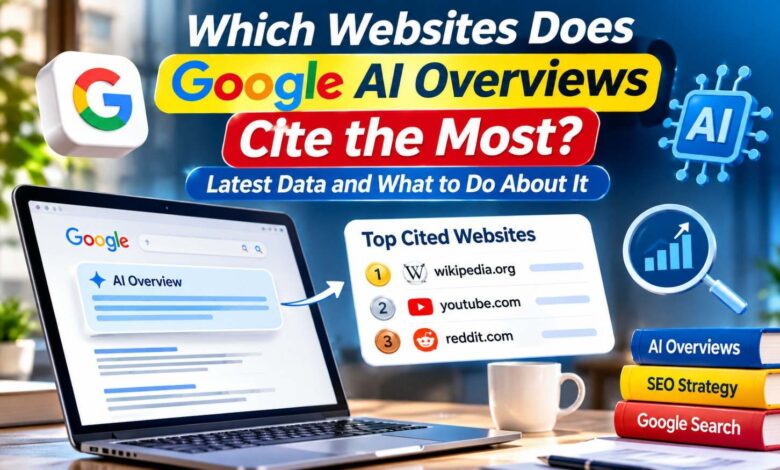
Which Websites Does Google AI Overviews Cite the Most? Latest Data and What to Do About It (November 2026)

Quick summary
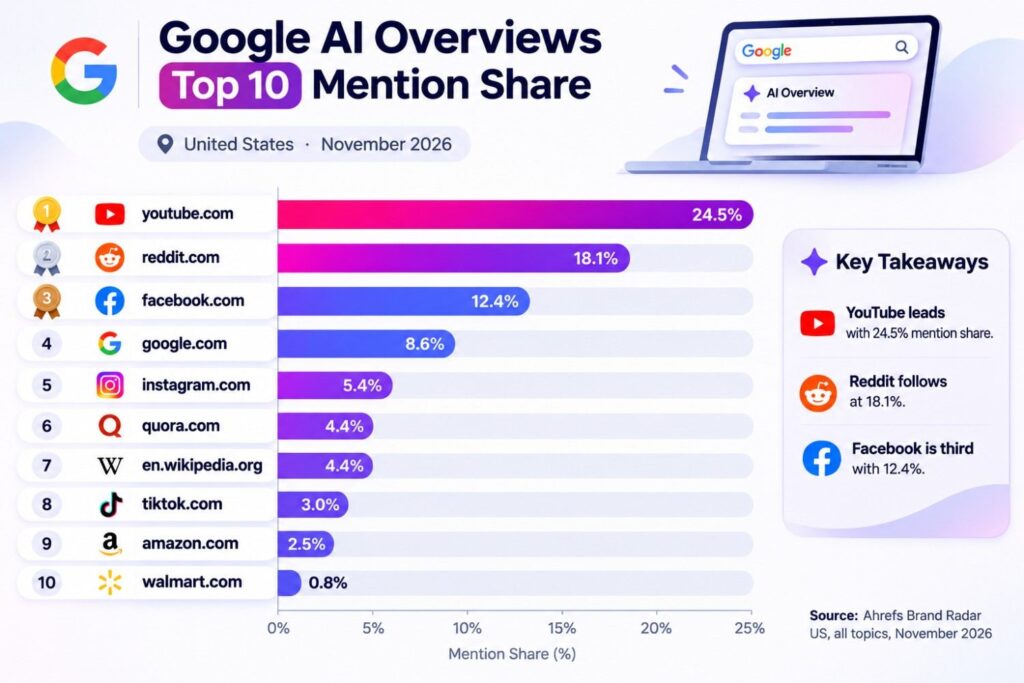
YouTube leads. It captures 24.5% of the citation share among the top 50 sources in Google AI Overviews, followed by Reddit (18.1%) and Facebook (12.4%).
Social and community platforms dominate. YouTube, Reddit, Facebook, Instagram, Quora and TikTok together account for roughly two-thirds (67.8%) of the top-50 citation share.
The long tail is niche and specialist. Beyond the top 10, every site holds 0.8% or less. Auto, health, finance and retail specialists fill most of the remaining slots.
Citation volume fell almost everywhere this month. Only Trustpilot grew (+1%); four new sites entered the top 50.
Why AI Overviews citations matter
AI Overviews are the AI-written summaries that sit above the classic blue links on Google. Google says they now reach more than 2 billion monthly users in over 200 countries, so being named as a source there puts your brand in front of an audience that no other AI assistant can match. The flip side is that these summaries answer a lot of questions on the results page itself, which is why publishers are nervous about lost clicks.
That makes one question worth asking: who is Google actually trusting as a source? The answer is less obvious than “the highest-ranking pages”, and it has direct consequences for how a blog like yours should plan its content.
The Most-Cited Websites in Google AI Overviews (November 2026)
The following table highlights the top 10 most-cited domains in Google AI Overviews for US-based search queries, based on Ahrefs Brand Radar data collected in November 2026. The analysis covers more than 3 million queries.
The figures represent each website’s share of citations among the top 50 cited domains, month-over-month citation changes, and the number of distinct pages cited.
| # | Website | Mention share | Rank change | Citation change | Pages cited | DR |
|---|---|---|---|---|---|---|
| 1 | youtube.com | 24.5% | — | ▼ 11% | 1,231,678 | 99 |
| 2 | reddit.com | 18.1% | — | ▼ 21% | 478,918 | 95 |
| 3 | facebook.com | 12.4% | — | ▼ 2% | 426,111 | 100 |
| 4 | google.com | 8.6% | — | ▼ 17% | 493,033 | 100 |
| 5 | instagram.com | 5.4% | — | ▼ 20% | 168,638 | 100 |
| 6 | quora.com | 4.4% | — | ▼ 22% | 108,149 | 92 |
| 7 | en.wikipedia.org | 4.4% | — | ▼ 14% | 62,881 | 97 |
| 8 | tiktok.com | 3.0% | — | ▼ 23% | 90,086 | 97 |
| 9 | amazon.com | 2.5% | — | ▼ 31% | 69,939 | 96 |
| 10 | walmart.com | 0.8% | — | ▼ 27% | 25,429 | 92 |
| 11 | edmunds.com | 0.8% | ↑ 2 | ▼ 10% | 18,389 | 86 |
| 12 | kbb.com | 0.7% | ↑ 4 | ▼ 3% | 24,367 | 89 |
| 13 | healthline.com | 0.7% | ↓ 1 | ▼ 27% | 6,203 | 92 |
| 14 | nerdwallet.com | 0.6% | ↑ 1 | ▼ 18% | 3,537 | 90 |
| 15 | forbes.com | 0.6% | ↓ 4 | ▼ 31% | 7,319 | 94 |
| 16 | linkedin.com | 0.6% | ↑ 2 | ▼ 22% | 15,923 | 99 |
| 17 | tripadvisor.com | 0.6% | ↑ 3 | ▼ 17% | 17,166 | 93 |
| 18 | homedepot.com | 0.6% | ↓ 4 | ▼ 33% | 11,391 | 90 |
| 19 | nytimes.com | 0.5% | ↑ 4 | ▼ 10% | 4,458 | 94 |
| 20 | ebay.com | 0.5% | ↓ 3 | ▼ 33% | 16,445 | 93 |
| 21 | justanswer.com | 0.5% | ↓ 2 | ▼ 28% | 14,555 | 76 |
| 22 | trustpilot.com | 0.5% | ↑ 9 | ▲ 1% | 9,539 | 94 |
| 23 | goodrx.com | 0.5% | ↑ 1 | ▼ 12% | 6,193 | 85 |
| 24 | webmd.com | 0.4% | ↓ 3 | ▼ 23% | 3,651 | 92 |
| 25 | pinterest.com | 0.4% | ↑ 5 | ▼ 12% | 13,915 | 97 |
| 26 | consumerreports.org | 0.4% | ↑ 1 | ▼ 16% | 4,521 | 91 |
| 27 | cars.com | 0.4% | ↑ 9 | ▼ 13% | 9,289 | 86 |
| 28 | pmc.ncbi.nlm.nih.gov | 0.4% | ↑ 7 | ▼ 17% | 8,252 | 95 |
| 29 | thespruce.com | 0.4% | ↓ 7 | ▼ 36% | 3,796 | 90 |
| 30 | cargurus.com | 0.3% | ↑ 8 | ▼ 11% | 6,437 | 79 |
| 31 | medium.com | 0.3% | ↓ 5 | ▼ 30% | 8,412 | 94 |
| 32 | target.com | 0.3% | ↑ 1 | ▼ 25% | 9,503 | 91 |
| 33 | bestbuy.com | 0.3% | ↑ 1 | ▼ 25% | 7,831 | 89 |
| 34 | cnet.com | 0.3% | ↓ 6 | ▼ 34% | 3,496 | 91 |
| 35 | lowes.com | 0.3% | ↑ 2 | ▼ 21% | 6,206 | 88 |
| 36 | seriouseats.com | 0.3% | ↑ 3 | ▼ 22% | 2,190 | 86 |
| 37 | businessinsider.com | 0.3% | ↓ 12 | ▼ 41% | 4,559 | 92 |
| 38 | rtings.com | 0.3% | ↑ 6 | ▼ 18% | 3,623 | 79 |
| 39 | yahoo.com | 0.3% | ↓ 10 | ▼ 42% | 7,060 | 94 |
| 40 | merriam-webster.com | 0.3% | NEW | NEW | 6,455 | 91 |
| 41 | angi.com | 0.3% | — | ▼ 29% | 3,049 | 90 |
| 42 | finance.yahoo.com | 0.3% | ↓ 2 | ▼ 31% | 6,608 | 94 |
| 43 | cnbc.com | 0.3% | ↓ 1 | ▼ 25% | 2,562 | 92 |
| 44 | tastingtable.com | 0.3% | ↑ 2 | ▼ 19% | 4,735 | 82 |
| 45 | wikihow.com | 0.3% | ↓ 2 | ▼ 24% | 4,400 | 91 |
| 46 | carfax.com | 0.2% | NEW | NEW | 5,387 | 90 |
| 47 | yelp.com | 0.2% | ↑ 3 | ▼ 14% | 8,362 | 94 |
| 48 | wallethub.com | 0.2% | NEW | NEW | 3,808 | 83 |
| 49 | byrdie.com | 0.2% | ↓ 4 | ▼ 29% | 1,892 | 85 |
| 50 | mayoclinic.org | 0.2% | NEW | NEW | 1,452 | 92 |
Source: Ahrefs Brand Radar, November 2026, US database, all topics. Figures reproduced from the November 2026 dataset.
Note: Rank change indicates movement compared with the previous month. NEW means a new entry in the top 50. Citation change represents the percentage change in citations compared with October 2026. DR stands for Domain Rating.
What the numbers actually tell us
1. AI Overviews lean heavily on people, not publishers
Add up the six social and community platforms in the top nine (YouTube, Reddit, Facebook, Instagram, Quora and TikTok) and you get 67.8% of the top-50 citation share. The first traditional publisher on the list, the New York Times, sits at 0.5%. Google appears to value first-hand experience, demonstrations and real opinions, and these platforms supply them at enormous scale.
2. YouTube is pulling away
Ahrefs’ own June 2026 snapshot had YouTube at 20.9%. Five months later it is at 24.5%. Other studies back up the direction of travel: Surfer SEO’s analysis of 46 million citations put YouTube at 23.3% of AI Overview citations, and AirOps found that roughly one in every 12 AI Overview citations goes to YouTube. AirOps also found that about 99% of YouTube citations point to one specific video, so Google is citing individual videos that answer a question, not channels.
3. The top is concentrated, and the rest is a long, thin tail
The ten biggest domains take about 84% of the top-50 pool. After Walmart (0.8%), every remaining site sits between 0.2% and 0.8%. Getting a place in that tail is realistic for a specialist site, but it will not be a traffic windfall on its own.
4. Specialists win their own verticals
- Automotive: Edmunds, Kelley Blue Book, Cars.com, CarGurus and Carfax all appear.
- Health: Healthline, WebMD, GoodRx, PubMed Central and, newly, Mayo Clinic.
- Finance: NerdWallet, WalletHub (new), Yahoo Finance and CNBC.
- Retail and home: Amazon, Walmart, eBay, Target, Best Buy, Home Depot and Lowe’s.
The pattern is the same everywhere: a site that is clearly the go-to resource for a narrow topic gets cited for that topic.
5. Citations dropped almost across the board
Of the 50 sites, 45 saw fewer answers citing them than last month, four are new entries (Merriam-Webster, Carfax, WalletHub and Mayo Clinic), and only Trustpilot grew, by 1%. The biggest drops were Yahoo (-42%) and Business Insider (-41%). A drop in raw citations does not necessarily mean Google trusts these sites less; it can also reflect changes in how often AI Overviews appear or how many sources each one lists. Treat one month as a signal to watch, not a trend.
Other recent research worth knowing
No single study tells the whole story, because each uses a different query set and method. These are the findings I would pay attention to:
- Citations aren’t always accurate. A September 2026 Washington University in St. Louis study found that an average AI Overview cites about eight sources, yet roughly 11% of verifiable claims were unsupported by, or contradicted, the cited source.
- Health answers favour video and research. LLM Pulse’s July 2026 data for US health questions showed YouTube cited in about 42% of answers, with the NIH domains next at about 24%. A separate SE Ranking study reported by The Guardian in January 2026 also found YouTube outranked every medical site.
- Top-10 rankings matter less than they used to. An ALM Corp analysis reported that the share of AI Overview citations coming from top-10 organic results fell from 76% to 38% over twelve months. Treat this as indicative, as it is a secondary report, but it matches what other studies say about Google drawing from a wider pool.
- Community content is volatile. AirOps data shows Reddit’s share of all AI citations peaked near 5.3% around the holidays and settled at 3.3% by June 2026. Do not build your whole strategy on one platform.
A practical playbook for a smaller site
You are not going to outrank YouTube or Reddit. You can, however, make your site the kind of source that gets quoted, and be present on the platforms that dominate. Here is the approach I would follow.
- Lead with the answer. Under each question-style heading, give the direct answer in the first two sentences, then expand. Summaries are built from passages, so a clear passage near the top of a section is easier to lift than an answer buried in paragraph nine.
- Publish something original. A small data set, a screenshot-backed test or a before-and-after result gives AI systems something they cannot get elsewhere. Generic rewrites of top-ranking pages are the easiest content for Google to ignore.
- Turn your best articles into short videos. Because YouTube is the single biggest source, a 3 to 6 minute video that answers one specific question, with a clear title, chapters and a transcript, gives you a second route into the same answer.
- Take part in Reddit and Quora honestly. Answer questions in your niche with real detail. Link-dropping gets removed and teaches nothing; useful answers get read, upvoted and cited.
- Earn mentions and reviews. Trustpilot was the only top-50 site that grew this month, which fits a broader pattern of AI answers leaning on what others say about a brand. Encourage genuine reviews and aim for coverage on other relevant sites.
- Go deep, not wide. The vertical winners above all own a narrow subject. Pick two or three topics, cover every question in them thoroughly, and link the pages together.
- Make claims easy to verify. Given the accuracy findings above, cite your sources, date your statistics and say what you tested. Content that is clear about where its facts come from is safer for an AI summary to quote.
- Keep the basics healthy. Crawlable pages, fast loading, accurate dates and a clear author. I am not aware of any special markup that guarantees inclusion, so beware of anyone selling one.
My practical notes: what to test and record
Rather than guess, run a small experiment for 30 days. This is the simple routine I recommend for a site of our size:
- Pick 10 to 15 queries you already rank for and check, weekly, whether an AI Overview appears and who is cited. Screenshot each result with the date.
- Rewrite five of those pages with answer-first sections and a short “key takeaway” box, and leave five untouched as a control group.
- Publish one short video for two of the rewritten pages and see whether the video or the page gets cited first.
- Track branded search and referral traffic in Google Analytics and Search Console, not just rankings. Clicks may fall even while visibility rises.
Our First-Hand Experience: 4SEOHelp.com Started Gaining Visibility in Google’s Generative AI Features
We recently started monitoring 4SEOHelp.com’s visibility in Google’s Generative AI features through Google Search Console, and the initial results are encouraging.
Our Google Search Console report shows 2.9K total impressions over approximately three months (August–November 2026) in the Generative AI features (Beta) report.
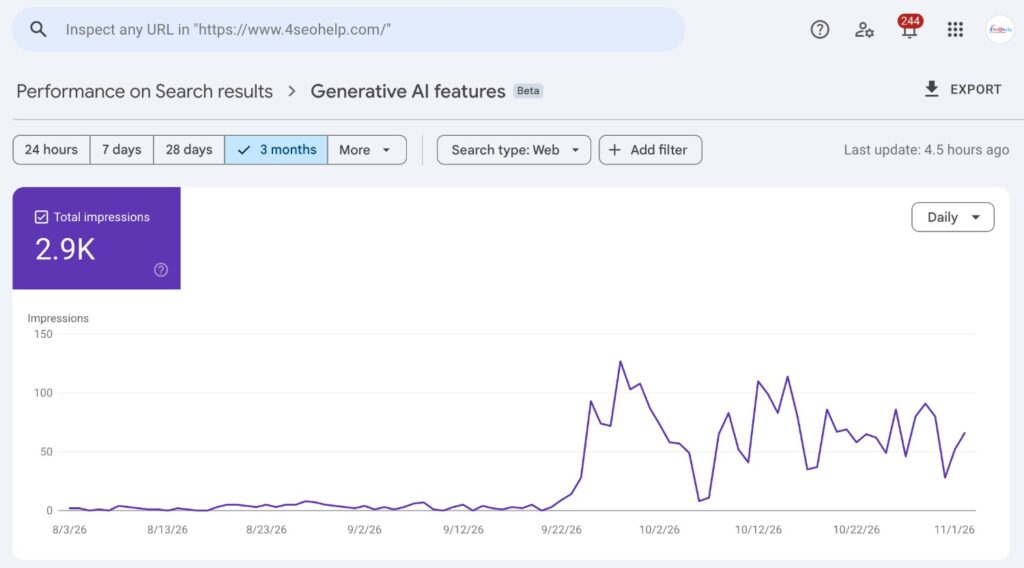
When we first started monitoring this data in August, impressions were relatively low. However, around September 23, we noticed a significant increase in visibility. Daily impressions subsequently reached approximately 125 at their peak, with continued fluctuations throughout October and into November.
This indicates that 4SEOHelp.com has started gaining visibility across Google’s generative AI search experiences.
What did we learn from this experience?
- AI search visibility can change significantly over a relatively short period.
- Monitoring AI-related impressions provides an additional way to understand search visibility beyond traditional organic rankings.
- Consistent publishing, useful information, clear explanations and original insights should remain central to our content strategy.
- AI visibility and organic website traffic are different metrics, so both need to be monitored separately.
We are continuing to monitor these results and identify which pages and topics contribute to our growing AI search visibility.
Our takeaway: Don’t focus exclusively on traditional Google rankings. Start monitoring your website’s presence in Google’s AI search experiences as well. Even smaller niche websites like 4SEOHelp.com can begin building visibility in this evolving search landscape.
How to track your own presence
Google Search Console does not currently separate AI Overview impressions cleanly, so you need a mix of methods. Ahrefs Brand Radar tracks brand mentions and cited pages in AI Overviews against your competitors. For a free approach, check your target queries manually in a logged-out browser window and keep a spreadsheet. Watch for results changing by location and by day, because AI Overviews are not identical for every user.
Final thoughts
The big lesson of November 2026 is that Google’s AI summaries rely on voices and experiences, not only on authoritative publishers. For a site like 4seohelp.com that means writing with real examples, publishing original results, showing up on YouTube and in communities, and being specific about the topics you want to own. Revisit the data each month, because the leaderboard is moving quickly.
Frequently asked questions
A small website can improve its chances of appearing in Google AI Overviews by publishing original, well-researched content that directly answers users’ questions. Focus on a specific niche, demonstrate first-hand experience, include reliable sources, maintain technical SEO and build topical authority. There is no guaranteed method for securing an AI Overview citation.
No. Google AI Overviews does not simply copy answers from ChatGPT or other AI chatbots. Google’s AI search features generate responses using Google’s own systems and information from sources available through Google Search. ChatGPT and Google AI Overviews are separate products with different retrieval and response-generation systems.
Yes. A website may be referenced in ChatGPT answers without ranking highly in Google Search. AI assistants use different search, retrieval and information sources. However, having useful, accessible and authoritative content can improve the opportunities for discovery across different platforms.
AI search engines can reference different types of content, including detailed guides, original research, expert explanations, product comparisons, case studies and first-hand experiences. Content that provides clear answers, verifiable information and useful context can be valuable sources for AI-generated responses.
Participating in Reddit and Quora can increase brand exposure and create opportunities for users to discover your expertise. These platforms also appear among frequently cited sources in the November 2026 Ahrefs data covered in this article. However, participation does not guarantee that your website will receive AI citations.
Backlinks can help search engines understand a website’s authority, reputation and relevance. However, there is no publicly confirmed backlink requirement for appearing in Google AI Overviews. Focus on earning relevant editorial links, publishing original research and building a trustworthy online presence instead of creating backlinks solely for AI citations.
Yes. Newly published pages can potentially appear as sources if they are discoverable, accessible to Google and relevant to a particular query. However, indexing does not guarantee citation. Publish useful information, maintain accurate references and ensure that important pages can be crawled.
Businesses can improve their chances of being discovered by AI systems by maintaining consistent brand information, publishing expert content, earning genuine customer reviews, securing relevant media mentions and creating helpful product or service pages. Brand information should be accurate and consistent across trusted online platforms.
Neither should be ignored. Traditional organic rankings remain important for attracting search traffic, while AI search visibility creates additional opportunities for brand discovery and recommendations. Businesses should monitor organic clicks, impressions, conversions, brand mentions and AI referral traffic together.
Use Google Analytics 4 to examine referral traffic from AI platforms, including ChatGPT and Perplexity, where identifiable referral information is available. Monitor Google Search Console for organic performance and available generative AI reporting. Also track conversions, engaged sessions and branded searches to understand whether AI visibility is creating business value.
This research and analysis are presented by Sonu Kumar Singh, Founder of 4SEOHelp, who has over 12 years of experience in SEO, digital marketing and website growth strategies. Through 4SEOHelp, he regularly studies Google algorithm updates, AI-powered search experiences, Generative Engine Optimization (GEO), search visibility and changing user search behaviour. This article combines his professional SEO experience, analysis of Ahrefs Brand Radar data, industry research and practical observations from monitoring 4SEOHelp.com’s visibility in Google’s generative AI features. His objective is to help website owners, bloggers and digital marketers understand how AI-powered search is changing SEO and how they can adapt their content strategies for sustainable online visibility.