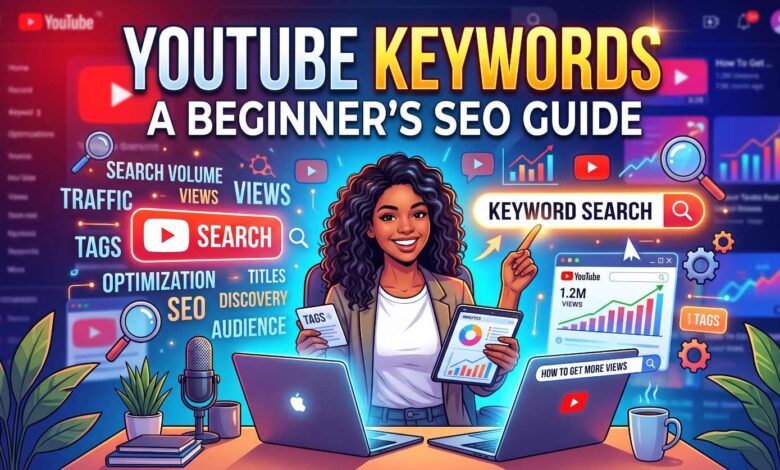
Well, if you’ve ever uploaded a video, and seen it get 0 views for weeks until 10 clips uploaded by another channel get thousands of views, then keywords are likely the missing link. YouTube is more than just a video site; it is the second-largest search engine online, and, as with search engine marketing, it works based on keywords. So, the silver lining of the situation is that it is not necessary to be a data scientist to nail this one. All you have to do is just know what YouTube exactly is looking for.
What I mean by YouTube Keywords
A YouTube keyword is any word or phrase somebody enters into the search bar while on the search for content similar to yours on YouTube. That may seem trivial, but here’s the thing that beginners do not get – YouTube doesn’t only match the keywords in your video title. It analyzes your title, description, tags, spoken audio (yes, that’s right, it loads the content you say into your video; also), how people react after they click. The key words are the starting point, but not the entire game.
See keywords as the connection between what people are looking for and the actual content that your video provides. YouTube knows really fast if that bridge is delicate, if that bridge is misleading — you can expect that people are going to click away from that page within seconds.
Begin with research and not speculation
There are few new creators simply slap on a title they think sounds like it’s coming out of their own mouth and go with it. There is something that user don’t want to make! When you need or thinking plan to start a type of topics into the youtube comment finder search bar, spend 10 minutes doing so and note down any suggestions that appear. Those suggestions are not hacks — they are directly sourced from search volume in reality; that is, it’s on-demand.
One can go further than that and see what is also appearing in your niche above the top-ranking content; that is also a great way to find similar videos, questions or comments that are important to your niche. This helps you get an idea of the topic cluster you are surrounded by, rather than a simple word. Even using a free tool, such as Google Trends, VidIQ, or TubeBuddy can give you 80% of the data on search volume and competition, without a paid tool.
The title is your first and most crucial keyword slot.
Here we are going to discuss about the topic which is the most significant thing on the page. It should contain your main keyword, preferably at the start as well, and it must be something that a person would click. A page name full of every possible ‘video editing’ you can imagine is not nearly as effective when it comes to how to edit videos faster (Beginner Tutorial).
Don’t stuff your title with key words because you can, that’s not a good strategy. YouTube’s ranking system is improved in the ability to identify natural phrasing as opposed to forced phrasing, and so have viewers. If the title “sounds funny,” it is a title the people skim.
Telling somebody to do something is more of a mental task than they might think
Most novices don’t write anything or they copy and paste one flaky sentence. That goes down the wires at zero rank in free. This is when YouTube reads the description and it is where you have the opportunity to use your primary keyword a few times naturally, but don’t overdo it, and use related terms as well.
This is a good format: in the beginning features 2 or three sentences containing the main word of your video and a description of the video. Then be as descriptive, as timelinked and linked as you can. Try to aim to skim through at least 100 words if you can (do you see what I did there? Short descriptions will give YouTube nothing to work with).
Hexe, tags still matter, although not as much as you think
The myth goes that tags hold the key to SEO. In practice, these days, tags serve only to help YouTube understand what context you’re in and pick up on misspellings of your primary keyword. Nonetheless, it helps to throw in some general and specific terms, such as the main keyword, a couple of close synonyms and perhaps your channel title or niche.
Do not allocate a lot of time to the characteristic of filling all the pipes with few connected tags, just to see if something sticks. A tight cluster of 8-10 pertinent tags is sufficient and is clean.
Read your video so that it is understandable
Beginners always miss out on this part. youtube comment picker automatically generates a caption for your video, and it can “hear” what you are saying in the video. It’s more than a text field because if you repeat your keyword in the video, say in the first few seconds to introduce your tutorial, you’re creating relevance in addition to just one with the text. Not much, no cost, and an added indicator for YouTube to follow.
With the help of the thumbs, the paired couples provide their performances. The paired couples perform with the aid of the thumbs and CTR.
Some keywords are required to be found in the search results; thumbnails and titles are the strategic combination to make it a click. Click-through rate (CTR) is a key factor for YouTube optimization, and if the video is not gleaned in the search results page, then it will eventually fall in rank. Here is your thumbnail that you should actually match and sell out the product item that you want in your title; no bait and switch, nothing that is completely different.
Consistency Beats Perfection
No more need to have get each element right the first time you upload. The most important part is developing a habit: Do research before you write the title, write real descriptions, instead of placeholders, and watch the analytics in YouTube Studio’s analytics to see which keywords are actually generating views. You’ll begin to see the trends over the course of time in what actions are most successful with your audience, which is much more valuable than a generic list of keywords.
Familiarizing yourself with YouTube’s SEO isn’t a game of the system. It’s all about providing more convenient access to a video that’s useful to the right people. If you start thinking of keywords as a means to your audience, instead of a method to outsmart nature, then it’s a lot easier to breathe, at least when it comes to their use.