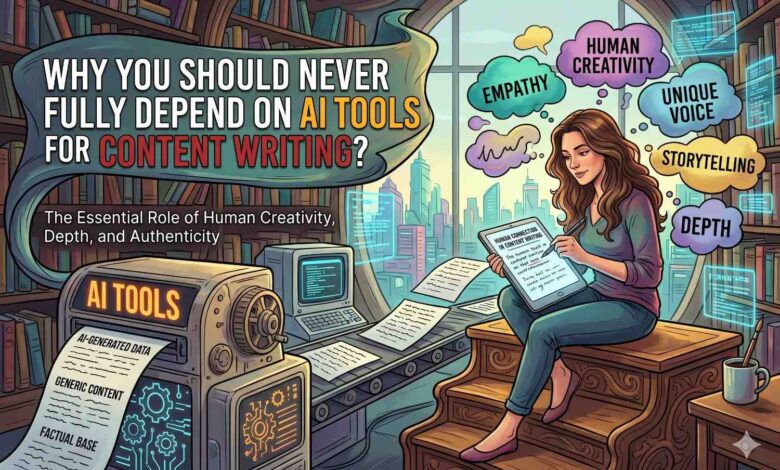
Why You Should Never Fully Depend on Ai Tools for Content Writing?

Key Takeaways
- AI tools help speed up content creation but cannot fully replace human writers.
- Human emotions and personal experiences make content more relatable.
- AI generated content often becomes repetitive and generic.
- Fact checking is necessary because AI can produce incorrect information.
- Strong brand voice usually requires human understanding and consistency.
- Search engines reward useful and people focused content.
- Creativity and originality still depend heavily on human thinking.
- Cultural context and sensitivity are areas where humans perform better.
- Readers trust authentic communication more than robotic writing.
- The best strategy is using AI as a support tool instead of a full replacement.
Have you noticed how AI tools are suddenly everywhere in content writing? From blog posts and product descriptions to social media captions and emails, many people now depend on AI to create content in minutes.
But here is the big question –
Is AI really enough to handle all your content writing needs without human thinking?
A lot of people search questions like these every day –
Can AI write better than humans? Is AI content good for SEO? Why does AI written content sometimes sound robotic? Can Google detect AI content? Should businesses completely replace content writers with AI tools?
The thing is, AI writing tools are useful. They save time, generate ideas quickly, and help people create drafts faster. But content writing is not just about arranging words together. Good content connects with emotions, solves real problems, builds trust, and reflects human understanding.
AI can support this process, but it cannot fully replace it.
AI tools work by studying huge amounts of existing data and predicting what words should come next. They don’t think like SEO Search Engines. They don’t have personal experiences, emotions, judgment, or deep understanding of your audience. Thats why AI generated content often feels repetitive, generic, or disconnected from real readers.
This article by experts of our best ecommerce SEO company in Delhi are explaining why you should never fully depend on AI tools for content writing, how AI should actually be used, and where human expertise still matters the most.
Why Depending Fully on AI Content Writing Can Affect Your Results?
If you run a business, write blogs, manage a website, or post content online, this topic directly affects you. The quality of your content shapes how people see your brand, trust your information, and interact with your business.
When content feels robotic or repetitive, readers lose interest quickly. They may leave your website within seconds. Search engines also track user behavior like bounce rates and engagement. Poor quality content can slowly reduce your visibility online.
Another important thing is trust. People connect with human experiences, honest opinions, and relatable communication. AI can imitate conversations, but it still cannot fully understand emotions, cultural context, or real-life situations the way humans do.
Important Reasons Never Fully Depend on AI Tools for Content Writing
AI Cannot Truly Understand Human Emotions
AI can generate emotional sounding sentences, but it does not actually understand feelings. It predicts language patterns based on data. Thats very different from real human emotion.
For example, if someone writes about personal loss, health struggles, parenting stress, or career failure, readers expect empathy and understanding. Human writers naturally bring emotional depth because they understand life experiences.
AI Content Often Sounds Repetitive
One common problem with AI generated writing is repetition. You may notice similar sentence structures, repeated phrases, and predictable explanations across different articles.
Even when AI tries to sound natural, experienced readers can often sense a pattern. The content may feel polished at first glance, but after reading more, it starts sounding generic.
The problem gets worse when many websites use the same AI tools with similar prompts. Content starts looking almost identical across the internet.
AI Does Not Always Provide Accurate Information
AI tools can confidently present incorrect facts. This is one of the biggest risks of depending fully on AI for content writing.
Sometimes AI mixes outdated information with current data. Sometimes it creates completely false details that sound believable. This is especially dangerous in topics related to health, finance, law, education, or technology.
Human review is necessary because factual mistakes can damage credibility and create confusion for readers.
AI Cannot Fully Understand Your Brand Voice
Every brand has its own style, tone, and personality. Some brands sound professional. Others sound friendly, playful, or deeply technical.
AI can imitate a tone to some extent, but it often struggles to maintain a consistent and authentic brand voice across all content pieces.
Human writers understand subtle communication differences. They know how to speak directly to your audience in a way that feels natural and genuine.
Search Engines Prefer Helpful Human Focused Content
Search engines like Google are becoming smarter at evaluating content quality. They focus heavily on experience, expertise, trust, and usefulness.
AI content alone is not automatically bad. But low-quality AI content that lacks originality and value may perform poorly in search results.
Google wants content that genuinely helps readers answer questions and solve problems. Human writers often provide better examples, practical insights, and personal understanding that improve content quality.
AI Cannot Replace Real Life Experience
Real experience adds depth to content. A human writer can explain what actually happened during a situation, what mistakes were made, and what lessons were learned.
AI does not have experiences. It only predicts patterns from existing information.
Readers value practical insights from real people because they feel more trustworthy.
Creativity Still Needs Human Thinking
AI is good at combining existing ideas. But true creativity often comes from human imagination, unexpected thinking, and emotional understanding.
Some of the best content online succeeds because it feels unique. It may contain humor, storytelling, unusual opinions, or fresh perspectives that AI alone struggles to create naturally.
Human writers know how to break patterns and make content memorable.
The thing is, creativity is not only about writing fancy sentences. Its about understanding what will emotionally connect with readers.
AI May Miss Context and Cultural Sensitivity
Language is deeply connected to culture, emotions, and context. AI sometimes misunderstands sarcasm, humor, local meanings, or sensitive topics.
A sentence that sounds normal in one region may feel offensive or confusing in another. Human writers usually understand audience context much better.
This becomes especially important for businesses targeting different locations, age groups, or cultural backgrounds.
Final Words
AI tools have changed content writing and digital marketing in many ways. They help people create drafts quickly, organize ideas faster, and improve productivity. Thats why they are becoming more popular every year. But here is the reality. Content writing is still deeply human. Readers want authenticity, emotional connection, useful experiences, and trustworthy communication. AI alone cannot fully deliver all of that consistently. When you balance technology with human understanding, your content becomes more useful, relatable, and valuable for real readers.
FAQs
AI content helps with speed, but human editing improves originality, search quality, and reader engagement for better long-term results.
Fully AI written content may contain repetitive wording, incorrect facts, weak brand voice, and poor emotional connection with readers.
Human writers understand customer emotions, market behavior, and storytelling better than AI tools during content planning and writing.
Businesses should check content accuracy, originality, readability, brand tone, and audience relevance before publishing AI generated articles online.
Human written content usually performs better because search engines value experience, trust, expertise, and natural reader focused information.
AI tools support faster drafting, but professional writers improve strategy, creativity, accuracy, and audience connection for stronger content quality.
Brands use AI for speed and research while human writers improve clarity, trust, originality, and customer focused communication.
Businesses should use AI for ideas and drafts while human experts review facts, tone, structure, and search optimization carefully.
Human edited AI content feels natural, improves reader trust, increases engagement, and supports better search engine visibility over time.