If you run a service-based business in multiple cities or regions, you’ve probably already heard that you need service area pages. And you probably already know that search engine optimization for those pages can get complicated fast. The moment you start building location pages, one question almost always comes up: how do I make each page unique without writing the same thing over and over?
It’s a fair question, and it trips up a lot of businesses.
The short answer is that you can absolutely build strong service area pages without duplicating content. It just takes a clear strategy, some honest effort, and a willingness to think about each location as more than just a name swap.
Here’s how to do it right.
Why Duplicate Content on Location Pages Is a Real Problem
Before getting into the fix, it helps to understand why this matters in the first place.
Google’s job is to serve the most useful, relevant result for any given search. When it crawls your website and finds several pages that are nearly identical except for the city name, it doesn’t know which one to show. It may choose one and ignore the others. Worse, it may see the pattern as an attempt to game rankings and discount all of those pages.
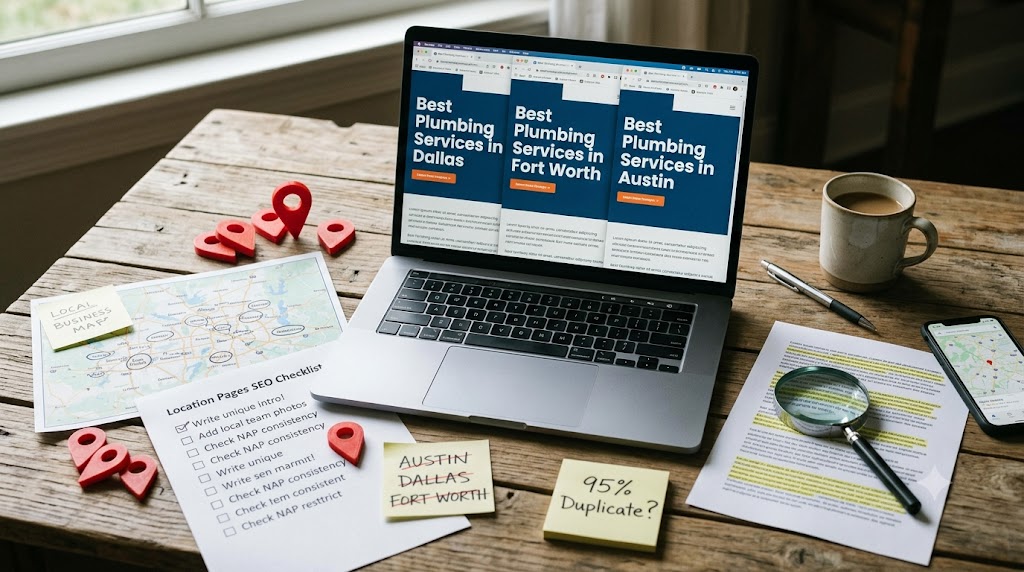
Thin location pages, meaning pages that just swap out a city name while keeping everything else the same, rarely rank well. They don’t give Google anything meaningful to work with, and they don’t give visitors any real reason to trust you.
The goal is to build pages that look, feel, and read like they were written specifically for that location. Not just technically different, but genuinely useful to someone searching in that area.
Start With a Consistent Page Structure, Not Identical Copy
There’s a difference between having a consistent structure and having duplicate content. Structure is fine. Identical copy is not.
Your service area pages can absolutely follow the same template in terms of layout:
- A headline that names the service and the city
- A brief intro about what you offer in that area
- A section covering the specific services available
- A section that speaks to the local area
- Social proof (reviews, case studies, or client mentions from that area)
- A clear call to action
That template can be the same across every location page. The content that fills it in should not be.
Think of it like a house. The floor plan can be the same. The furniture, the photos, the personal touches inside each one should be different.
Write Genuinely Unique Intros for Each Location
The intro paragraph is one of the first things both Google and your visitors will read. It sets the tone for the entire page, and it’s also one of the easiest places to differentiate.
Instead of writing “We provide HVAC services in Lancaster,” try writing something that speaks to what that specific market looks like. Does that city have older homes that tend to have certain heating and cooling challenges? Is it a fast-growing suburb where new construction is booming? Is it a commercial corridor where businesses need specific solutions?
You don’t need to write a novel. Even two to three sentences of genuinely local context makes a meaningful difference, both for how the page reads and how it signals relevance to search engines.
A useful exercise: before writing each page, ask yourself, “What would a customer in this specific city actually want to know?” That question alone will push you toward better, more differentiated content.
Localize More Than Just the City Name
The most common mistake businesses make with location pages is thinking that changing the city name is enough localization. It isn’t.
Here are a few ways to add real local depth to each page:
Reference local landmarks or neighborhoods. You don’t need to be overdone about it, but mentioning that you serve businesses near a specific business district or residential area makes the page feel grounded. It tells the reader that you actually know the area, not just that you’re willing to drive there.
Use locally relevant language. Different regions have different ways of describing things. Pay attention to how people in that area talk about the services they need.
Mention service-specific details for that location. If there’s something about the geography, climate, regulations, or demographics of that city that affects how you work there, put it on the page. A plumbing company serving a coastal town might deal with different water quality issues than one serving an inland suburb. That detail is genuinely useful.
Pull in reviews from that area. If you have clients or customers in that city, their feedback is some of the most powerful local content you can put on a page. It’s unique, it’s credible, and it directly connects your work to that location.
Don’t Rely on Spinning or Slight Rewrites
There are tools and techniques that promise to make location page creation faster by spinning content, automatically rewriting sentences to create “variations.” These rarely work well, and they can actually make things worse.
Spun content tends to read awkwardly, and search engines have gotten good at recognizing it. More importantly, visitors can feel when something doesn’t read naturally. If your location page sounds like it was assembled by a machine, it doesn’t build the trust you need to convert that visitor into a lead.
The time you save using shortcuts usually costs you in results. It’s better to write fewer pages well than to launch dozens of thin ones quickly.
If you’re stretched for time, consider rolling out your location pages gradually. Start with your highest-priority markets, write them properly, and expand from there. A handful of strong pages will outperform a hundred weak ones.
Handle the Core Service Description Carefully
Here’s where most businesses struggle: the core description of what you do doesn’t change just because the city does. If you’re an IT company, your managed services offering is the same whether you’re serving a client in Philadelphia or Pittsburgh.
So how do you handle the section that explains your actual service without just copying it across every page?
A few approaches that work well:
Summarize rather than repeat. Instead of copying your full services page description word for word, write a shorter, localized summary for each location page. You’re giving enough context for the reader to understand what you offer without lifting the exact block of text from another page.
Lead with local pain points. Frame the service description around what businesses or homeowners in that specific area tend to struggle with. This naturally produces different copy across cities because the framing is different, even if the solution you’re describing is the same.
Use different formatting. Even if the substance of what you’re describing is similar, presenting it as a list on one page and as short paragraphs on another adds enough variation that it reads as distinct content. This isn’t a substitute for genuine differentiation, but it helps when combined with other tactics.
Think About Internal Linking Between Location Pages
A well-structured set of service area pages should connect to each other and to your core service pages in a logical way. This helps search engines understand the relationship between your pages and distributes authority across your site.

A good practice is to link location pages back to your main service pages, and to create a central “Areas We Serve” or “Service Locations” page that links out to each individual location page. This gives Google a clear map of how your content is organized and reinforces that each location page is part of a larger, intentional structure rather than a collection of thin standalone pages.
Avoid Creating Pages for Every Possible City
More pages are not always better. A common mistake is building a location page for every city within a 50-mile radius, including places where you have no customers, no reviews, and no real presence.
Search engines can tell the difference between a page that reflects real local expertise and one that exists purely to capture search volume. If you don’t actually serve a market or don’t have anything genuine to say about it, that page is likely to underperform and potentially drag down the credibility of the pages that do matter.
A better approach is to focus your location page strategy on the areas where you actually do business, where you have clients or case studies, and where you have a real shot at ranking competitively. Build those pages well. Then expand.
The Bottom Line
Service area pages work when they’re built with the reader in mind, not just the algorithm. Each page should give someone in that city a reason to believe you understand their market, their needs, and their situation.
That doesn’t require starting from scratch every time. It requires a smart structure, a genuine local angle, and the discipline to write content that actually earns its place on each page.
Get that right, and your location pages become one of the most valuable parts of your site.