
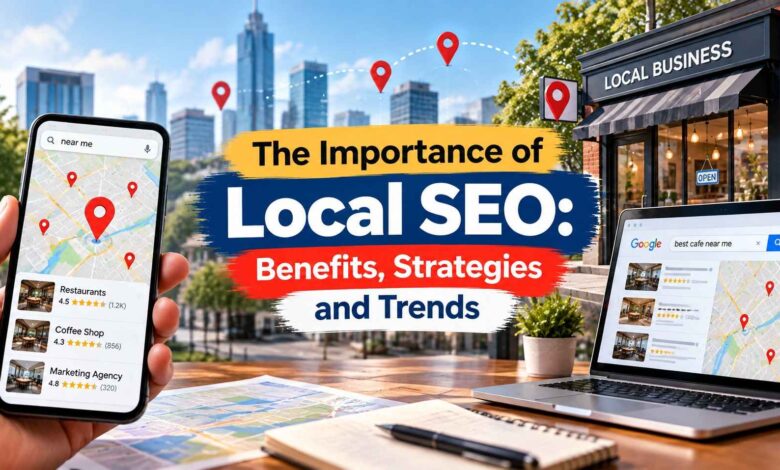
If people near you cannot find your business online, you are handing customers to your competitors. Local SEO is the practice of making your business visible in searches tied to a place: “dentist near me,” “best bakery in Chicago,” or “accounting firm in Delhi.” It matters most for small and medium businesses, service providers, clinics, restaurants, and multi-location brands that depend on customers in a specific area.
The fundamentals have not changed, but the way people find businesses has. Google now answers many local searches with AI-generated summaries, Maps results and review snippets, often before a visitor clicks anything. This guide covers why local SEO still matters, what it consists of, and what is working right now.
What Is Local SEO?
Local SEO optimizes your online presence so that you appear when people search within your geographic area. Google decides who to show using three long-standing factors: relevance (how well you match the search), distance (how close you are to the searcher), and prominence (how well known and trusted you appear online).
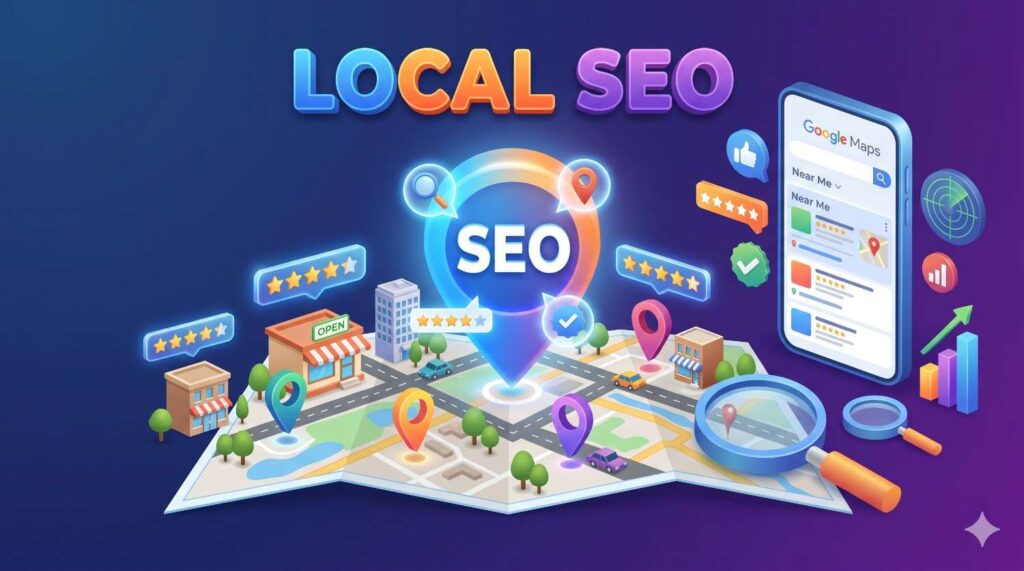
A business that sets these signals up properly shows up in the local pack, in Google Maps, and increasingly inside AI-generated answers.
Why Local SEO Matters
It reaches people who are ready to act. Local searches are usually made on a phone, often with immediate intent to visit, call, or book. Someone searching “emergency plumber near me” is not browsing; they are choosing.
It builds trust and credibility. A complete profile, genuine reviews, and a consistent address tell both customers and search engines that your business is real. This also matters if you work from a shared or serviced office: showing your location raises visibility and credibility.
It levels the playing field. A smaller business with an active, well-managed Google Business Profile can outrank a bigger competitor whose profile is neglected.
It delivers high-quality leads. Overall search impressions may be lower in the age of AI answers and zero-click results, but the visitors who do act, by calling, requesting directions, or visiting your site, tend to be far closer to buying.
It is cost-effective. Compared with broad advertising, local SEO puts your effort in front of the people most likely to become customers.
The Core Elements of Local SEO
1. Google Business Profile (GBP)
GBP, formerly Google My Business, is still the single most influential local asset. Treat it as a living page, not a one-time setup:
- Verify your profile. Unverified profiles are effectively invisible.
- Choose the most accurate primary category, then add relevant secondary ones.
- Use your real business name, with no keyword or city stuffing.
- Complete every field: hours, services, products, attributes, and your service area.
- Upload your own clear, current photos and short videos of your premises, team, and work. Authentic images beat generic ones.
- Post updates, offers, and events regularly, and use the Q&A and messaging features where available.
Don’t stop at Google. Claim and maintain profiles on Bing Places, Apple Business Connect, and relevant industry directories, since Maps apps and AI assistants draw on them too.
2. Consistent NAP Details
Your name, address, and phone number (NAP) should be identical on your website, GBP, social profiles, and every directory. Use a local phone number where possible and keep it the same on every page. Inconsistent data spreads: many sites pull information from one another, so one wrong listing can lead to errors across the web. Audit your citations periodically and correct mistakes at the source.
3. Reviews and Reputation

Reviews now influence more than rankings. They affect clicks, calls, and how AI summaries describe and compare you.
- Ask every satisfied customer for a review, ideally with a short direct link sent by WhatsApp, SMS, or email.
- Aim for steady, recent reviews. Count, average rating, and how many arrived in the last few months all shape perception, and a profile with no recent reviews looks stagnant.
- Reply to every review, positive or negative, professionally. Responses show you are active and engaged.
- Don’t fear a few negative reviews. A flawless record can look suspicious, and an honest mix makes the good reviews more believable.
- Never buy or fake reviews. Google actively enforces against it.
Remember that much of your online reputation is built offline. How you treat customers face to face is the best way to control what the internet says about you.
4. Local Keywords and Location Pages
Use natural, location-specific phrases in titles, headings, meta descriptions, and body copy (for example, “family dental clinic in Dwarka”). If you serve several areas, create genuinely useful, unique pages for each location or service area rather than copying one page and swapping city names. Duplicate service-area pages are a common mistake that weakens results.
5. Local Content
Publish content that matters to your community: local events, neighborhood guides, case studies from nearby clients, and answers to questions people in your area actually ask. Add an FAQ section to key service pages. Clear, direct answers are easy for both searchers and AI systems to understand and quote.
6. Local Links and Mentions
Earn links and mentions from chambers of commerce, local news, sponsorships of events or teams, neighboring businesses, and industry associations. These signal prominence, and third-party mentions carry visible weight in AI-generated local recommendations.
7. Social Presence
A Facebook page, Instagram account, or other active profile keeps you reachable and gives customers more places to find proof that you are real. They only help if you keep them updated and answer messages.
Local SEO Trends to Watch in 2026
AI Overviews and AI search are reshaping local discovery. Google increasingly assembles local answers from your website, GBP, reviews, and mentions across the web. Assistants such as Gemini and ChatGPT also make location-based recommendations. The inputs are largely the same as classic local SEO, which means a strong profile and honest reputation serve both goals. Review text and third-party mentions count for more in these summaries.
Zero-click behavior is rising. Many searchers get what they need directly from the results page. Your profile therefore has to work as a landing page: complete, visual, and easy to act on with one tap.
Entity clarity and structured data matter. Search engines treat your business as an entity with defined attributes. Use LocalBusiness schema, keep details consistent, and link your website clearly to your profiles so machines can understand who you are, where you operate, and what you offer.
Engagement signals carry weight. Calls, direction requests, website clicks, photos, posts, and review replies all show that a profile is alive. Set-and-forget profiles lose ground.
Visual proof builds confidence. Fresh photos, short videos, and genuine staff and project images help people choose you and give platforms richer information to display.
Mobile and voice searches keep growing. Conversational, “near me” and question-style queries favor businesses with clear hours, services, FAQs, and fast mobile pages.
Experience and trust are essential. Real expertise, real locations, real customers, and transparent business details count for more than shortcuts. Keyword-stuffed business names, fake addresses, and bought reviews put your profile at risk of suspension.
How to Measure Results
Track a handful of metrics each month rather than chasing every number:
- Local pack and Maps visibility for your main queries
- Calls, direction requests, and website clicks from your profile
- New reviews and average rating
- Conversions from local landing pages
If these are trending upward, your local SEO is working.
A Quick Local SEO Checklist
- Claim and verify your Google Business Profile, Bing Places, and Apple Business Connect listings
- Choose accurate categories and fill in every field
- Keep name, address, and phone identical everywhere
- Upload original photos and post updates regularly
- Request reviews consistently and reply to all of them
- Create unique location or service-area pages with local FAQs
- Add LocalBusiness schema to your website
- Earn local links, partnerships, and mentions
- Review your numbers monthly and keep your information current
Conclusion
Local SEO remains one of the most practical ways to get found by customers who are nearby and ready to act. The tools and surfaces have changed, from classic listings to AI summaries, but the principles are the same: be accurate, be visible, be active, and earn genuine trust. Businesses that treat their online presence as an ongoing effort, and back it up with excellent service offline, will keep winning local search.
Frequently Asked Questions
Most businesses see early movement in Maps visibility, calls, and direction requests within one to three months after fixing their profile, citations, and reviews. Competitive categories and cities take longer, often six months or more. Results depend on your competition, how complete your profile was to begin with, and how consistently you keep working on it, so treat local SEO as an ongoing process rather than a one-time project.
Yes. Your profile can bring in calls and visits, but a website gives search engines and AI systems the detailed proof they need to trust you: services, team credentials, location pages, FAQs, and customer stories. Businesses with a profile and no supporting website are easier to ignore than those with both. Your site is also the one asset you fully control if a profile is ever suspended.
Yes, if it genuinely serves customers in specific areas. Set up your profile as a service-area business, hide your home address, and list the areas you actually cover. Never use a fake or virtual address to appear in a city where you have no real presence. Google can suspend such profiles, and the damage to your visibility can be hard to reverse.
There is no separate trick. AI systems draw on the same sources that power local rankings: a complete profile, genuine review text, clear service pages, consistent business details, and mentions on trusted local websites. Answer real customer questions in plain language, show who is behind the business, and keep every detail accurate. Content that demonstrates first-hand experience is easier for both people and machines to trust.
Both, but in different ways. A healthy volume of reviews builds credibility, while detailed, specific reviews that mention the service and the area give search engines and AI summaries more to work with. Recency matters too, since a steady flow looks more trustworthy than a burst followed by silence. Ask real customers at the right moment, respond to every review, and never pay for or fake feedback.




I like your article it look great to me. Thanks